 of everything we do

Paced bottle feeding
If you wish to give your baby a bottle of expressed breast milk, you may find that using a paced approach helps them cope with the flow to more mimic how breast milk is delivered. You can find a short video on YouTube.
Coping with night feeds
Becoming a parent is a very special time. Getting to know your new baby and learning how to care for their needs can be one of the most rewarding experiences of your life. However, it can also be challenging, especially when you are tired, and your baby is wakeful and wanting to feed frequently during the night. It might be reassuring to know that it is both normal and essential for your baby to feed during the night. Babies grow quickly in the early weeks and months of their lives and have very small stomachs. Therefore, they need to feed around the clock to meet their needs. This great leaflet talks about how top tips for night feeds.
Breastfeeding and returning to work
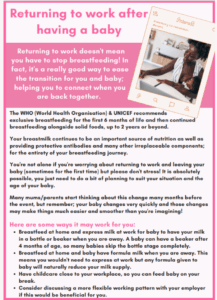
Going back to work or study may be the first time you have been separated from your baby for long periods. Continuing to breastfeed helps to keep the close relationship you’ve built up, providing your baby with extra comfort and security for as long as you both want. You don’t need to stop breastfeeding just because you’re returning to work or study. Many women find ways to continue breastfeeding their baby. Employers and course providers have certain obligations towards breastfeeding women to support your return to work or study. Please click on the below leaflet for more information.
Introducing solid foods
Breast milk is all the nutrition your baby needs for their first 6 months of life. At around 6 months, your baby should start to do 3 things, which indicates they are ready for solid foods.
Babies who are not ready will push their food back out, so they get more around their face than they do in their mouths. The Department of Health now recommends that babies be exclusively breastfed for at least six months and that breastfeeding is continued, with the addition of appropriate weaning foods, for as long as the mother and baby want. Please see this leaflet for more information.
Whether you’re breastfeeding, formula feeding or combination feeding, our Infant Feeding Team offers friendly, evidence-based advice to help you and your baby get off to the best start.
If you’re a parent, carer or professional looking to refer a family for extra support, our Health Visiting and Family Nurse teams are here to help.
Supporting families across Solihull with trusted health advice and care — from birth through to young adulthood.