 of everything we do
‘The two public health interventions that have had the greatest impact on the world’s health are clean water and vaccines’ World Health Organisation
What is immunisation?
This is a way of protecting against serious infectious diseases. Immunisations enable our bodies to fight those diseases better if we come into contact with them.
Does my baby have to be immunised?
It is your decision whether to have your baby immunised. Vaccinations are recommended because they give your baby protection against serious diseases, most of which can be fatal.
When are babies immunised?
It is really important that your baby has their immunisations at the correct age. The first ones are given at 8 weeks old. Further doses are given when they are 12 and 16 weeks old.
Below is a table showing when and what immunisations are given.
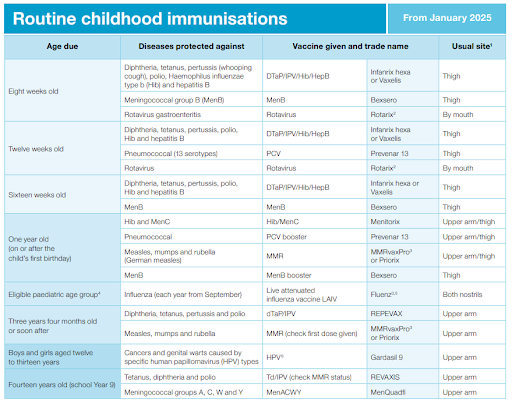
Routine childhood immunisations from 1 January 2025 – GOV.UK
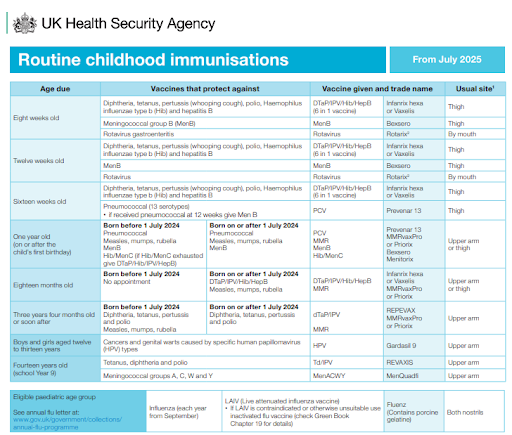
Please be aware of the changes to routine childhood vaccinations scheduled for 1st July 2025 and 1st January 2026.
These changes apply to newborns vaccinated from 1st July 2025 and babies born after 1st July 2024, children born before these dates will continue the original schedule.
For more information on these changes visit: Upcoming Changes to the UK Childhood Vaccination Schedule: Key Updates for Healthcare Professionals. – Immunisation & Vaccination Courses
Many of these diseases are particularly serious in young babies and can kill or cause lasting damage to their health, which is why it is important to protect your baby as early as possible.
How do I know that the vaccines are safe for my baby?
All medicines, including vaccines, undergo thorough testing to ensure they are safe and effective. The safety of vaccines is continuously monitored. All medicines can cause side effects, but vaccines are among the very safest. Immunisations are the safest way to protect your baby’s health.
How will I know when my baby’s immunisations are due?
If you register your baby at the GP shortly after birth, you will receive a reminder or an appointment for the immunisations. All routine childhood immunisations are free.
What happens at the appointment?
The doctor or nurse will explain what will happen and answer any questions you may have. Most vaccines are given into the thigh or upper arm, and Rotavirus is given as drops in the mouth.
What if I miss the appointment?
If you miss the appointment or need to change it, be sure to contact the GP surgery and arrange another. It is never too late to have your child immunised, even if they have missed immunisations and are older than the recommended age. Talk to your GP, health visitor, or practice nurse for advice.
I am worried my baby will be upset during the injection
Yes, your baby may cry for a few minutes, but a cuddle will help to make them feel better. If breastfeeding, this can also help; they will soon settle down.
Will there be any side effects from the vaccine?
Some babies may:
If my baby has allergies, can they still have vaccines?
Yes. Allergies do not prevent your baby or child from having vaccines. If you have any questions, speak to your GP, practice nurse or health visitor.
Can some babies be allergic to the vaccines?
Very rarely, some babies or children can have an allergic reaction soon after the immunisation. The nurse or GP will know how to treat this. People who give immunisations are trained to deal with any allergic reactions.
Paracetamol
To help prevent or treat a high temperature, it’s recommended you give your baby child’s paracetamol after their MenB vaccinations at 8 weeks and 16 weeks old.
You’ll need to give your baby 3 doses of paracetamol. Give them 1 dose as soon as possible after being vaccinated, a 2nd dose 4 to 6 hours later, and a 3rd dose 4 to 6 hours after that.
Make sure you leave at least 4 hours between each dose and do not give them more than 4 doses in 24 hours.
Remember: bring your red book to each appointment.
For further information, visit: NHS vaccinations and when to have them
Whether you’re breastfeeding, formula feeding or combination feeding, our Infant Feeding Team offers friendly, evidence-based advice to help you and your baby get off to the best start.
If you’re a parent, carer or professional looking to refer a family for extra support, our Health Visiting and Family Nurse teams are here to help.
Supporting families across Solihull with trusted health advice and care — from birth through to young adulthood.